Miss Hinchcliffe—Miss Murgatroyd
A Murder Is AnnouncedMiss Hinchcliffe—Miss Murgatroyd is a relationship formed around a difficult act of remembering: Miss Hinchcliffe urges her friend to reconstruct what she saw during the shooting, and Miss Murgatroyd’s recovered observation identifies the empty place that exposes the deception. Their exchange supplies the crucial interpretive bridge between a fragment of memory and the solution to the murder.
The Attempt to Remember
After Miss Murgatroyd has begun to recover what happened, Miss Hinchcliffe presses her to recall what she saw. Charlotte Blacklock, listening outside the cottage window, realizes that Miss Murgatroyd may have noticed something capable of endangering her. Miss Hinchcliffe then leaves for the station, while the conversation with her friend has brought Miss Murgatroyd close to a discovery she cannot yet fully explain.
The crucial words are “She wasn’t there…” Miss Marple later asks Miss Hinchcliffe whether Miss Murgatroyd said the phrase in that form: the wording matters because it refers not simply to a person who might have been absent, but to a space in the scene that should have been occupied. The relationship thus becomes the setting for an act of assisted recall—and for a distinction between remembering a person and remembering where a person ought to have been.
Reconstructing the Scene
Guided by Miss Hinchcliffe’s prompt to think about the three women, Miss Murgatroyd initially approaches the memory by considering people. Miss Marple explains that this focus would have led her to identify whichever woman seemed personally significant. Instead, the phrase points toward an unfilled place: Miss Murgatroyd had retained the arrangement of the room without immediately understanding what that arrangement meant.
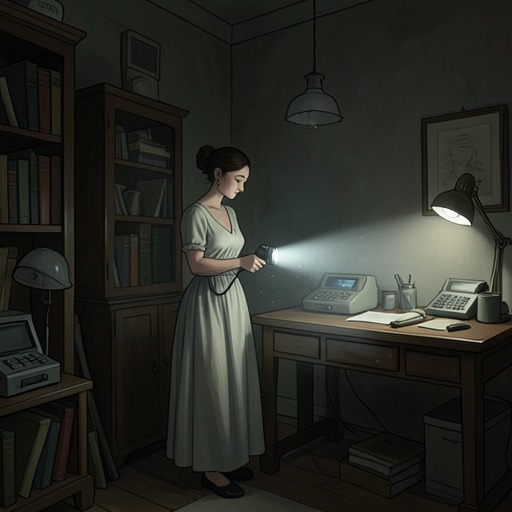
Following the path of the torch, Miss Murgatroyd’s recollection passes the mantelpiece, the two windows, and people positioned between them. She remembers Mrs Harmon covering her eyes and Miss Bunner staring, then recalls the wall and table with a lamp and cigarette-box. When the shots are fired, the memory settles on the wall where Letitia Blacklock was later supposed to have been standing. At the moment Letitia was said to have been shot, that place was empty. Miss Murgatroyd’s words therefore identify Letitia—not one of the three women she had been asked to consider—as the person who was not there.
Significance of the Relationship
Miss Hinchcliffe helps make the memory recoverable, but its decisive force comes from the exact shape of Miss Murgatroyd’s recollection. She does not initially announce a complete explanation; she gives an apparently puzzling phrase that Miss Marple can interpret by distinguishing a missing person from a remembered vacancy. The friendship’s role in the investigation is consequently both practical and evidentiary: the prompt elicits the memory, and the memory supplies the spatial clue.
Miss Marple also checks the wording with Miss Hinchcliffe, because a different emphasis would have changed its meaning. In the final reconstruction, this exchange converts an incomplete recollection into evidence that Letitia’s apparent shooting was staged. The relation between the two women thus contributes directly to the exposure of the impersonation and to the coherent pattern Miss Marple says emerged when the isolated clues came together.